Patrick Coffey
Think about how much more you're using AI today than even a year ago. It’s changing the way work, they way we think, and the way we solve problems. And for businesses, the opportunities are enormous. But turning that potential into reality, particularly at scale is far from straightforward.
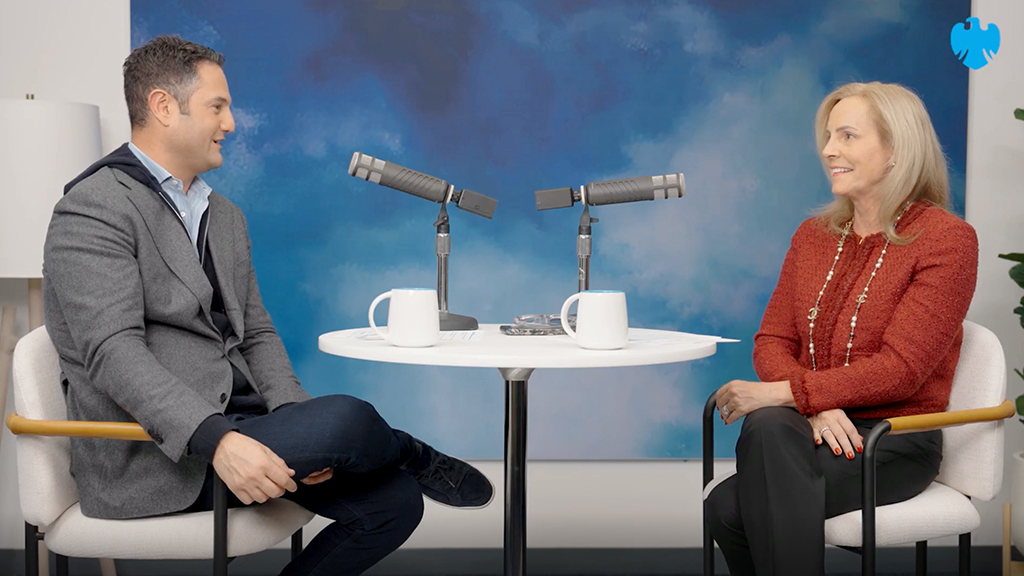
To explore this more, Ronnie sat down in New York with Anne Marie Darling, our Co-Chief Operating Officer at Barclays, who helps run the technology strategy and implementation.
I hope you enjoy their conversation.
Ronnie Wexler
Anne-Marie, welcome to the Brief.
Anne Marie Darling
Thanks for having me, Ronnie.
Ronnie
Your first time, I have a feeling. Won't be your last, though. Especially with how quickly technology is moving, how fast the world is moving. We're clearly in a time of enormous change. We're going to speak a lot about that. But why don't we, before we kind of get into the here and now, fast forward in our minds: If we're sitting here in three years, how has the banking industry changed in your mind? How has the way we serve our customers changed in your mind?
Anne Marie
It’s tough
Ronnie
We had to start somewhere
Anne Marie
It's impossible to predict the future, given how quickly the pace of change was over the past six months.
Ronnie
Right.
Anne Marie
However, there's real structural shift happening. First of all, from a customer perspective, the opportunity isn't another chatbot. It's really agentifying the customer journey and workflows. And that will mean simpler, seamless, personalized and proactive experience that will really differentiate firms. The second is around colleagues. Everyone's using AI assist, I’m sure, you use it in your personal life and now it's moving to agentic.
So how do they think about the workflows? What does that mean, managing human and digital across complex workflows that you now have to orchestrate between the two? And all of that is really changing significantly. The other thing that really stands out is re-engineering businesses. So it's not about just making the horse go faster, it's about transforming a transportation system.
So the firms that differentiate themselves will be the firms that really reimagine the workflow and have a significant step function change. And the last is ruthless discipline on execution.
Ronnie
So it's all moving fast, hard for most people, sometimes me to keep up. How do you think about the way you prioritize our path forward and the way you prioritize the way we scale this technology?
Anne Marie
That's a great question. What we're really first focused on is enabling experimentation and innovation, because we really need that to happen to have those great ideas surface. But we then need to take that, put it as a proof of concept in a pilot. Is it working? Is the agent performing like we're expecting it to? Is it appropriate against the evals [evaluations] that we've set out?
And then do they earn the right to scale? And scale really goes against ‘do we have the right infrastructure in place to do that?’, ‘Do we have the right adoption?’ And importantly, ‘how are we prioritizing the high value AI initiatives?’, ‘Does that impact the customer where we want it to?’, ‘Is it reducing risk for the firm and is it increasing resiliency?’
And of course, ‘is it driving efficiency?’ which we've already seen to date. But that's what's really driving our overall prioritization.
Ronnie
So you mentioned experimentation earlier. You even brought the personal element of it. I have an interesting confession to make. Just this week I gave my own personal AI access to all my financial information, to my personal email. It was like very terrifying to do.
Anne Marie
You’re better than me Ronnie, I’m not there yet!
Ronnie
It was terrifying to do. But I have to tell you, it's liberating. Now that I have this, I can't stop and the work that it can do for me and just I feel so much more in control of my personal life. I feel like I have my hands on the wheel in a totally different way, and I, and I can see how this experimentation, this risk taking is just going to cause all these breakthroughs and everything that we do. And I'm excited about it. But you mentioned agents as well as we move into the agentic phase, so AI taking action on our behalf, on our businesses’ behalf, on our behalf as individuals and our personal life.
How do you think about risks and controlling those in that world where we're headed?
Anne Marie
Yeah, ultimately, you could do a lot more in your personal life than you can in our regulated environment. There's really four things that we're focused on. The first is the foundation. So do we have the right infrastructure in place? The right harness around the model, the right evals, and importantly, the right way to measure and look at the guardrails.
The second is around each AI use case and the life cycle. ‘What is the business outcome that you're trying to define?’ So start there, it's not about the technology
Ronnie
Right.
Anne Marie
Do you then have the right risk and controls around that outcome?’ How you then deploy that safely into production?
And we're very focused on that life cycle. The two other things we're focused on is enterprise. So how do these different AI use cases create dependencies across each other? Are we thinking about the resiliency across the firm? And do we have flexibility to move from different models if we were required to?
And then the last is really about soundness and scalability more broadly. And that's everything we put in place around our governance, transparency, observability and really linking each agent to a personal identity and access management. So we know exactly who it's tied to and the guardrails in place in terms of what it's allowed and approved to do.
Ronnie
Well, you spend a lot of time with AI leaders out there. Do you think they understand the magnitude issues of deploying this technology in a regulated fashion in a regulated industry like ours? And then also, what are some of the lessons of being at the forefront of this with those tech leaders? And how can we maybe apply some of that to what we do here?
Anne Marie
First of all, I think there's two sides to that. One: these technology companies are bringing innovation. They’re on the tip of the spear from a frontier perspective, and so we could learn a lot from that. And really developing our partnerships allows us to benefit. But the second is, as you know, our environment is quite regulated.
Ronnie
Yeah.
Anne Marie
And so to industrialize that technology, it has to be done in a certain way to ensure the safety and soundness of our customers data, all the money movement that happens across the firm to ensure we're doing that in the appropriate way. And so both sides can really learn, and that's a journey.
Ronnie
Let's move this to the lens of markets. A lot of what we do around here, what are some of the things around this phase shift in this journey that you think they should be acutely focused on right now?
Anne Marie
Well, the first is around compute. Obviously there's been a lot of discussions around compute. And so we should pay close attention to the supply around that, the demand, how we can access that and what that means over the next 3 to 5 years. So that will be a significant part of the equation. The second is around capabilities, right. This is moving quite quickly. I would say it's just like AI is similar to electricity, right? It's getting cheaper and there's more access, but it doesn't mean our consumption is going to go down. It really means how do we deploy it in so many different ways we haven't thought about. And so that capability as it evolves will be very important.
And then the other thing we're really thinking about is where do we build versus buy.
And so there's lots of benefits to get to market quickly by partnering with someone. But you also have to do it in the right way to ensure its industrialized in a regulated environment.
Ronnie
So you're at the forefront of major technological change. How has it changed the way you work personally?
What are some things that are different today versus maybe a year ago in your own workflow?
Anne Marie
So for me, I used to obviously do what everyone else did, efficiencies on email, drafting, helping me write a speech. Maybe not quite to the level you are in terms of bank accounts.
Ronnie
You'll get there, you'll get there.
Anne Marie
But what I'm spending a lot of time on is more the critical thinking. So if I have a hypothesis or an idea, what are the risks I haven't thought about? Where am I potentially not being as, where I'm more biased in my approach? How do I think about that? How is somebody pushing back on me? I mean, you should think about A, B and C. And I find that to be quite helpful. Now we're going to move into a world where I'm going to have the agents that are orchestrating much more complex workflows for me, where I will be delegating things to. Of course, I will be in the loop, but that's the part I'm really excited about.
Ronnie
So let's spend a little bit of time on the advice you would give to folks in the broader business world. There's a lot of anxiety around this change and how quickly it's happening. What advice would you give broadly to people in the professional world on how to embrace this technology and make the most of it?
Anne Marie
Yeah, there's a couple of things I would think about for me personally, and then more broadly. The first is curiosity is the most important, you need to experiment, innovate, you need to be hands on.
Ronnie
Yeah.
Anne Marie
Otherwise you're going to get left behind. The second is, cultural. As leaders, if we're not driving this and setting a good example, it's going to be pretty hard for anyone else in your team to change their behavior.
And then the third part is can you drive real change and have impacts? And that's the part that's most exciting.
Ronnie
Let's end on the next generation. My kids are young, they're in first and third grade, but they're constantly coming home asking about AI, asking about why it's such a big deal to everybody, asking about what it means for them. How do you advise them on how to make the most of this in their lives?
Anne Marie
Let's be honest. They're advising me and they're further ahead, as I really say.
Ronnie
That's probably that's probably comforting, right?
Anne Marie
I think that's a generational thing.
Ronnie
Good.
Anne Marie
I love learning from my kids. But what I what advice would you give them is, is similar like, be very curious. Right. You need to innovate and continue to learn and evolve not as it relates to just the technology – in general. The second is have deep domain expertise. Right? Because this technology is going to automate some parts of the workflow.
But the individual who's really deep and has domain expertise is going to leverage the automation to have a better outcome. And then lastly really think about overall leadership and how you're thinking about your team members around that and bringing them along the journey.
Ronnie
That's great. It's very bullish to me to see that the next generation is already way ahead of us.
Anne Marie
They’re passing us, Ronnie
Ronnie
And embracing this means that means there are some very good things to come. This was amazing. I really enjoyed spending time with you here. Thank you for all your insights.
Anne Marie
Great. Thanks for having me