Patrick 00:00
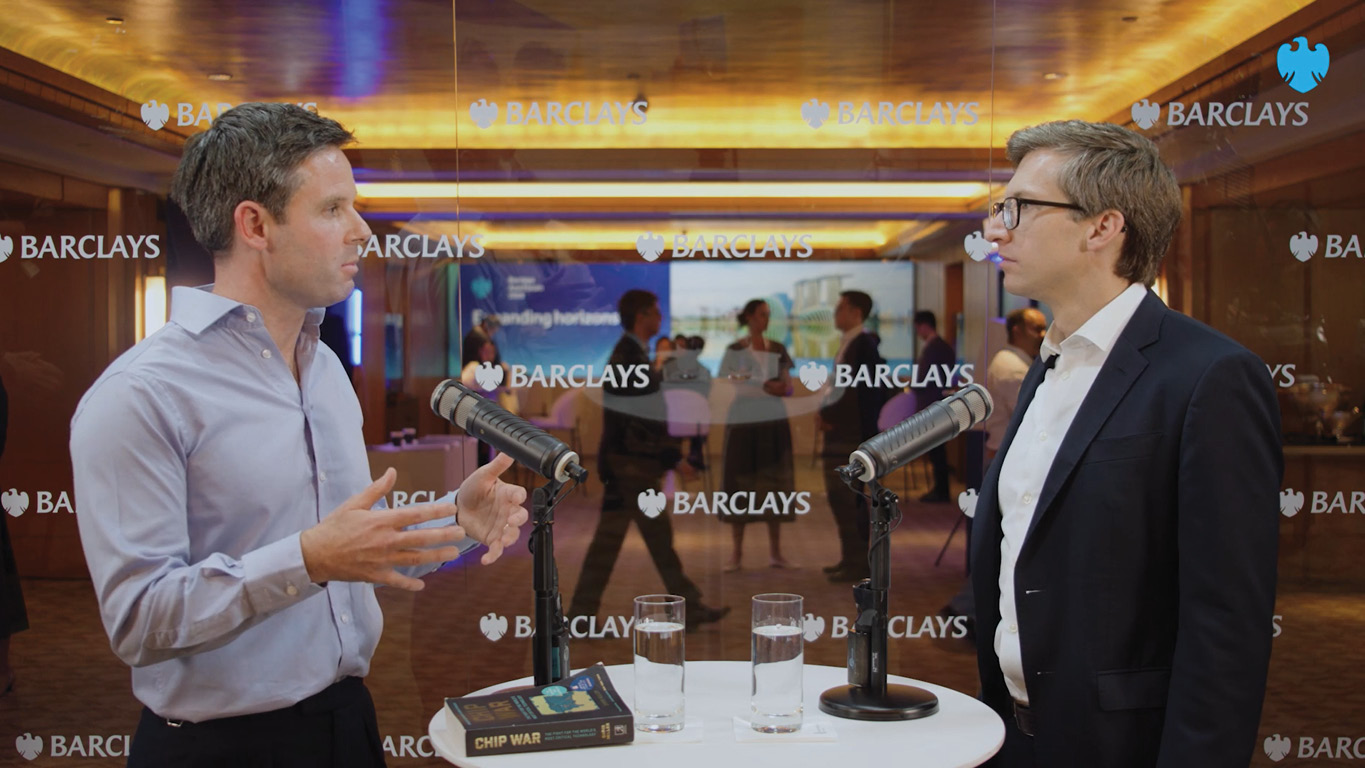
I bet when you woke up this morning, the first thing you thought about wasn't semiconductor chips. But think about it, the phone in your pocket, the car outside, the laptop at your desk, none of them would have worked without these tiny chips. And right now, these minute pieces of silicon are at the beating heart of the AI revolution. The problem is, never in world history has an economic revolution relied on such a fragile supply chain with so many critical vulnerabilities. To talk about all of this and a lot more, I'm delighted to be joined by Chris Miller, academic and author of the award-winning book, Chip War: The Fight for the World's Most Critical Technology. Chris, thanks a lot for being here.
Chris 00:43
Thank you.
Patrick 00:44
So I should say at the start, anything you say today isn't representative of the Tufts University or the Barclays Group, and we shouldn't think of it as investment advice. Chris, I want to talk about the last decade. We've seen huge change. We've seen the rise of protectionist economic policies, geopolitical tensions, and COVID. And at the same time, there's arguably been a shift from globalisation to global fragmentation. How much of that do you think can be traced back to semiconductor chips and technology?
Chris 01:12
I think chips have really been at the centre of this geopolitical competition because both in Washington and in Beijing, political leaders have realised that if you don't have access to the most advanced chips, you can't make the most advanced AI systems. And so for already over a decade, both countries have been in an effort to build a more resilient, self-sufficient supply chain, not complete self-sufficiency, but more access to the critical components that tech companies in both countries require.
Patrick 01:38
What are the trends that you're seeing in the supply chains that are impacting the global economy?
Chris 01:44
Well, first, there's a surge of investment in building data centres full of the most advanced chips, and this is requiring sourcing new tools and new materials and new packaging capabilities from around the world that's stressing these supply chains. And secondly, the supply chains have to adjust to this era of geopolitical competition. In the past, you could have a supply chain that stretched from China to the United States. Today, that's a lot more complicated.
Patrick 02:07
I was reading your book, and I kept going back and thinking about a board game I used to play when I was a kid at Christmas. It's called Risk.
Chris 02:12
I used to play that a lot.
Patrick 02:13
Did you? Really?
Chris 02:14
I did, yeah.
Patrick 02:14
Amazing. When I think about Risk, I always think that the most important thing isn't the number of armies you've got, it's actually owning the right territories and owning the right chokepoints. Is that the right sort of analogy to think about the semiconductor industry?
Chris 02:28
Yeah, I think it is, and if you look at key chokepoints, whether it's making chip-making equipment or the advanced manufacturing, there's a small number of companies that have these critical capabilities that are highly economically valuable as well as politically influential.
Patrick 02:41
Okay, so I want to talk about where the most important chokepoints are today.
Chris 02:44
Some of the chokepoints are well-known, like the advanced lithography systems that ASML produces or the manufacturing capabilities at Taiwan's TSMC. These have been understood now for some time, but if you dig deeper in the supply chain, like the advanced materials, the high-spec gases that are required to actually manufacture semiconductors, there's a small number of companies, largely in Japan, that have really unique capabilities to produce materials at the requisite level of purity.
Patrick 03:12
I feel like the conversation around materials just isn't discussed enough in this industry. What about critical minerals as well? You know, again, that's a big topic of a debate when Trump meets Xi. How should we think about critical minerals with regards to semiconductor chips and this industry?
Chris 03:27
Well, it's a key question. China is the world's leading producer of rare earths, of both gallium, germanium, indium, tungsten, all of which are needed in the production of semiconductors, either the chips themselves or in the supply chain that's used to produce chips. When you dig into the materials that undergird the chip industry, there's a lot of unique capabilities, advanced materials that only a small number of companies can produce. So if you look at, the materials, for example, in advanced packaging, bringing different chips together in different places, Japanese companies have really unique capabilities at ultra-precise production of these materials.
Patrick 04:01
Actually, you think the advanced packaging is one of the key chokepoints right now?
Chris 04:05
It certainly is, and there's tons of investment going into this space, just as we speak.
Patrick 04:08
Well, what are the changes you're seeing there at the moment?
Chris 04:10
So first, we're stacking chips on top of each other in new ways. Second, we're bringing different types of chips right next to each other and enhancing the communications between them. We're doing all this as the amount of heat that chips produce grows and grows, which requires innovation to dissipate that heat.
Patrick 04:26
Okay, so those are the kind of technological innovations we're seeing today. Let's think about geopolitics. US restrictions on China's access to certain semiconductor industries, paradoxically, did that not force China to try and go it alone and try and build their own chip industry?
Chris 04:43
I think it's certainly true that China is trying to build its own self-sufficient supply chain. We see it in chips. We see it in chip manufacturing. We see it in the effort to build their own chip-making equipment. It's still the case that when it comes to the ultra-complex chip-making tools, China's got a long way to go, though.
Patrick 04:58
But do you think realistically, in the next five to 10 years, chip-making self-sufficiency is possible for either the US or China, or is the industry just too interconnected for that to actually happen?
Chris 05:09
I think it's going to be very hard and very expensive for either China or the US to become self-sufficient. Look at AI chips right now. Both countries are critically reliant on AI chips sourced from Taiwan, and that's not going to change anytime soon. Well, certainly governments are going to try to change things on the margin, but it's just so difficult that it's going to take a very long time to fully materialise.
Patrick 05:29
Okay. So Chris, when you, when you published the book Chip War, your timing couldn't have been better. It was just before the US put restrictions on China for access to chips, and it was right at the start of the AI revolution. What's changed the most in the industry since you published the book?
Chris 05:44
Well, a couple things have changed. First, the surge of investment in AI data centres full of the most advanced chips has surprised everyone in terms of the scale, and second, it's come as political leaders in both Beijing and Washington have tried to exert even more influence over AI supply chains, imposing export controls not just on chips, but on AI models themselves, and that's led to an even more politicised supply chain.
Patrick 06:08
How should we think about that going forward? Because you could argue it's kind of peak politicisation, if that's a word, but arguably it could get even more political. Where do you think we're going with that?
Chris 06:17
I think political leaders in most countries are just beginning to understand how powerful AI is going to be, how politically and economically impactful it will become, and as they realise that, they'll want more control, not less. So I think we have more politicisation to come.
Patrick 06:30
Yeah. What about AI applications now? Where do you think we're going to see the major increases that's going to impact compute demand?
Chris 06:37
Well, certainly enterprise workflows is where we've seen the most demand right now, starting with software, financial services, professional services. But the next wave will be in other spheres, biotechnology, for example. Using AI to accelerate R&D or physical AI. Deploying AI in the real world. And so enterprise workflows are just beginning to be transformed, and many companies have a long way to go, so that alone will drive compute demand. But then look at AI for biotechnology and pharmaceuticals. Using AI to accelerate the R&D process will be extraordinarily valuable, and that's still in the early stages there, too. Finally, physical AI. Using AI to power robots and drive autonomous cars and fly drones. This is going to be, very impactful as well, and right now we're just beginning to develop these capabilities. It'll take a decade to fully deploy them.
Patrick 07:24
Physical AI, let's talk about that for a moment. Where do you think that research development will go?
Chris 07:29
The first challenge of physical AI is the supply chain, because you don't only need the chips, you need the sensors, the actuators and motors, the magnets inside of those motors. And so putting together a supply chain, driving down costs, bringing up quality is a real challenge. It's Chinese firms that are largely the leaders in that supply chain. Second is building models that are especially high quality, because you need 99.9999% accuracy to be allowed in the physical world, and that's something that, robotics companies are just beginning to, find a way to master. But for the brains, which might be where most of the value accrues, it's still too early to tell. There are capable companies in China, there are capable companies in the US, still early stages for that race.
Patrick 08:11
Yeah. And at Barclays we've written a lot about physical AI. I want to talk about, you talked about brains, I want to talk about human brains and how humans work in this industry, because I was rereading your book the other night at the same time as my wife was reading Harry Potter to our kids, and what struck me was that so often in this industry, CEOs or boards didn't take a risk on technology when they should have done, and they lived to regret it. A bit like all of those publishers that turned down Harry Potter and JK Rowling. So, as you look at the industry today, where are the mistakes being made?
Chris 08:44
I think the first big mistake is to underestimate the way that AI will impact not just the way you do business, but the entire business model. It's sort of like the transition from taxis to Uber or shopping in stores to shopping online. Most companies really struggle with these huge business model shifts.
Patrick 09:01
What about the mistakes at the board level around the semiconductor industry, whether that's supply chain, technology, lithography?
Chris 09:08
Well, here I think the big challenge for boards is to take into account the geopolitical dynamics that we started our conversation with. There's so much pressure from all of the major governments to reshape supply chains, and it's very hard for companies to really understand how they can get ahead of these trends.
Patrick 09:22
Do you think that's, you know, your book's so well-researched, and you looked at all of these companies and the history of their founders and their CEOs and the people working for them. Do you think that's the curse of the incumbent? Ultimately you become so good at defending what you've built that you miss what's going to replace it.
Chris 09:38
It's a hard challenge, but the best companies are those that are able to take those risks, cannibalise their existing businesses to capture the opportunity that AI is going to provide.
Patrick 09:47
Are there any countries where those companies sort of exist that you would be looking at right now? Is it Taiwan? Is it Japan? Any in Europe?
Chris 09:53
I think in all of those geographies you have companies that face versions of this dilemma, and the question is going to be, "Can they sacrifice their existing businesses to pivot in a different direction?"
Patrick 10:03
And so we're going to see some pivots no doubt, but if we're here in a couple of years' time talking at the Barclays Asia Forum, what do you think are the trends that we're not talking about today that we should have been?
Chris 10:14
Well, I think we, we understand right now what the digital AI landscape is going to look like, chatbots, agents, enterprise, workflows. But as AI enters other segments, we touched briefly on biotechnology and pharma, material science can have major implications for how R&D is done, and we're just beginning to think about what that might look like. Second, physical AI will be deployed widely across the economy in a decade's time, and we're beginning to see some of the use cases that might come. And finally, we started our conversation with politisation. There's more to come on that front as all of the world's economies, not just China and the United States, but also medium and smaller countries, develop their own regulatory frameworks to regulate AI in their own economies. And so I think we need to focus on that politisation 'cause more will come.
Patrick 10:59
Yeah. I've got to ask you, smaller countries, which ones should be looking at in terms of the regulation?
Chris 11:03
Well, I think really every country's going to have their own regulatory framework to address the social concerns that they have or the political concerns that they have. So just like every country regulated social media in their own way, I think the same's going to happen in AI.
Patrick 11:17
What are you working on at the moment? I see you've just published an article about AI and drones and military. What's next?
Chris 11:21
I'm spending a lot of time on the physical AI world. I think this is the next decade-long trend when you learn to imbue physical systems with AI level of intelligence.
Patrick 11:30
Chris, thank you so much for joining at the Barclays Brief today. Really great having you here.
Chris 11:34
Thank you for having me
Patrick 11:36
It's been great to talk to Chris today, and here are the things I'm going to be watching. First of all, physical AI. He talks about it a lot. It's a theme that at Barclays we've been writing a ton about, and clearly it's going to have a profound impact on the world economy over the next 10 to 20 years. Secondly, increased politicisation of AI and supply chains. Arguably, we're only at the start of that politicisation, but it isn't just the US and China. Many other countries are going to regulate in a big way in the future. And finally, biotech and pharma. These are themes that will be impacted dramatically by AI and of course the supply chains from all of those chips. If you've enjoyed today's conversation, do hit subscribe to the Barclays Brief. Thanks for tuning in, and we'll be back next week